Direct Booking Website for a Guesthouse: What You Really Earn by Leaving the OTAs
€100 paid on Booking.com means €83 in your pocket. On your own direct booking site, it is €97. Same guest, same property, €14 more per booking. Here is the math, and how to set up a direct booking website without becoming a developer.
You own a guesthouse, a vacation rental, a B&B. You are on Booking.com or Airbnb (or both). And on every booking, 15 to 20% of what the guest pays never reaches you.
This is not an opinion, it is a line on your statement. On €16,000 collected through online travel agencies (OTAs), €2,400 to €3,200 leave in commissions every year.
The one channel that escapes this cut is direct booking on your own website. For most owners I meet, it is the biggest lever for improving profitability, ahead of dynamic pricing, ahead of multi-platform distribution, ahead of extras.
This article explains why, how much it really changes, and how to set up a site without becoming a developer.
What exactly is a "direct booking website"?
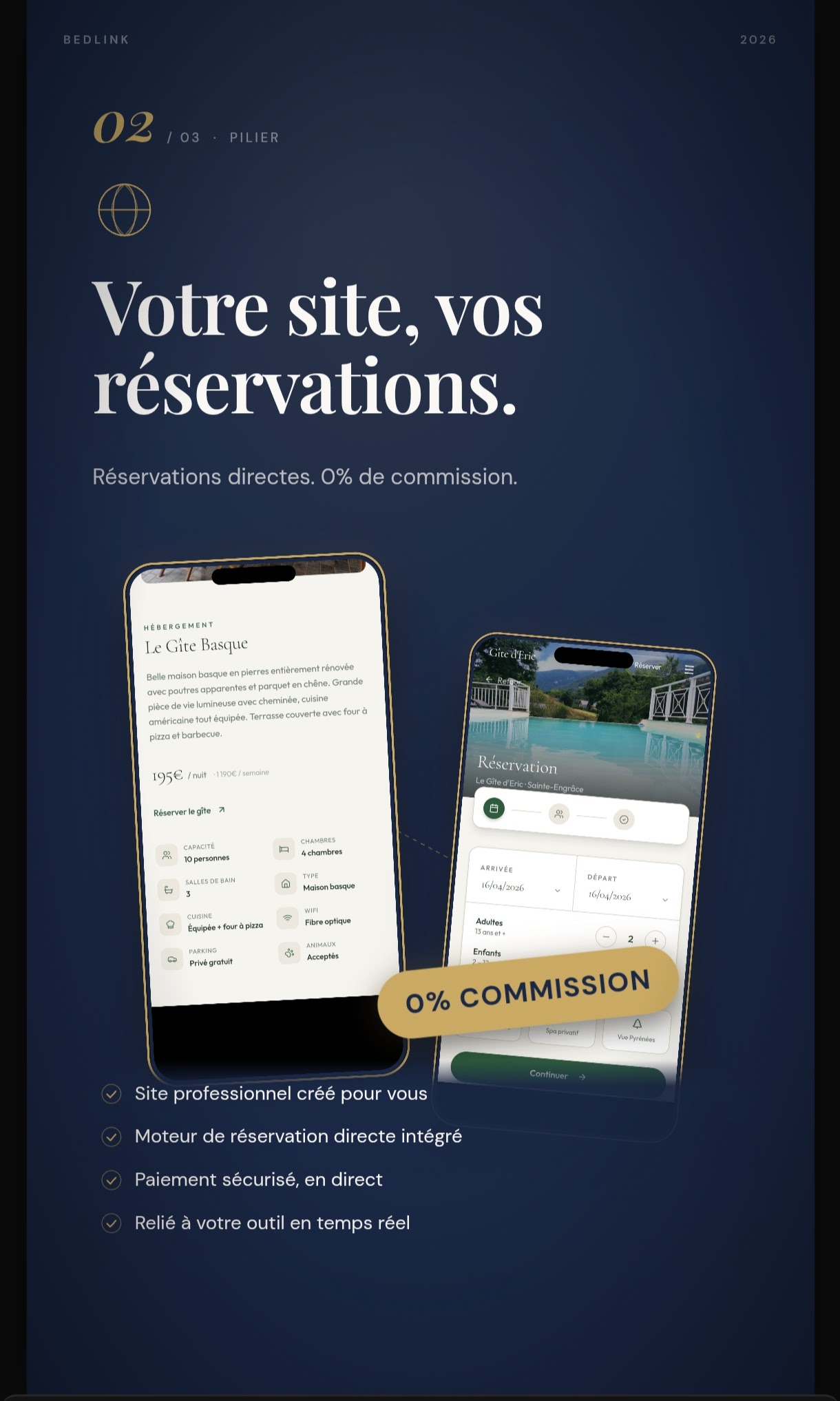
A direct booking website is your own website (not an Airbnb page, not a Booking.com listing) with:
- A showcase that presents your property your way (your photos, your story, your style)
- A built-in booking engine (the guest picks dates, sees the price, books online)
- Secure payment (credit card, Stripe or equivalent)
- Synchronization with your channel manager (dates block everywhere in real time when someone books)
It is not:
- A simple Facebook or Instagram page
- A contact form where the guest writes to ask about availability
- A showcase with no way to book (so the guest still has to call you or go to Booking.com)
The difference is huge. Without the booking engine and the built-in payment, your site does not exist for 80% of travelers. They want to book now, pay now, get their confirmation now. Not call. Not wait.
The real calculation: €100 paid, what stays with you
Here is the scenario I tell in one of my videos. A traveler looks for a guesthouse for a weekend away.
Scenario 1: they book through Booking.com
| Step | Amount |
|---|---|
| The guest pays | €100 |
| Booking.com commission (~17%) | −€17 |
| You receive | €83 |
Scenario 2: they book through your direct site
| Step | Amount |
|---|---|
| The guest pays | €100 |
| Stripe card fees (~3%) | −€3 |
| You receive | €97 |
Difference: €14 for every €100.
On a property earning €16,000 a year, if you manage to move 30% of your bookings to direct (a realistic ratio 18 to 24 months after launching the site, with a bit of loyalty effort), you get:
And that is without lowering your price by a cent. If you offer a small perk for booking direct (a 5% discount, or a welcome basket), you attract even more travelers to the direct channel, you still come out ahead, and the guest wins too.
The mental trap: "nobody will use it"
This is the number one objection I hear on calls. "Nobody will find my site."
It is both true and false.
False, because some of your guests already find you on Google (your name, your town, your property's name). They land on your Airbnb page or your Booking.com page, and they book there. If your direct site ranked better, they would land on it instead. That share is typically 15 to 25% of your guests, and it is free: it is just a matter of pointing them to the right place.
True, because at the start your direct site has no Google authority. You have to actively promote it to the guests who stay with you. And that is where the real mechanics of direct booking begin.
The method: turning an Airbnb guest into a direct customer
The guest who books with you through Airbnb for the first time is not technically your customer. They are Airbnb's customer who happens to sleep at your place. And the next time they go on vacation, it is Airbnb that will reach out to them, not you.
But for 2, 3, 5 days, they are physically in your home. You have a window. And there are 3 simple things to do to turn them into a real customer.
1. The welcome booklet with a QR code
A printed booklet (8 to 12 pages, A5, decent quality) that covers:
- How the property works (wifi, heating, appliances)
- Your local tips (bakery, restaurants, walks, activities)
- A QR code on the last page, pointing to your direct site, with a line like "Next time, book direct on our website, you save and so do we."
The guest remembers the booklet. They talk about it to their family. And they keep the QR code on their phone.
2. The take-away business card
A clean card (not a folded A4 flyer), left next to the guestbook or on the table. The guest picks it up before leaving. It has:
- The name of your property
- Your website (a short, memorable URL)
- Your phone number
- A hook: "Direct = no commission"
It is ridiculously simple. Yet 80% of owners do not do it.
3. The post-stay email (or message)
48 to 72 hours after they leave, a short message. Not a sales email. A personal note:
"Thank you for staying with us, we hope you enjoyed it. If you have 30 seconds, a review helps us enormously (Google or TripAdvisor link). And if the urge to come back strikes, you know where to find us: booking through our website directly is cheaper for you and simpler for us."
Short. Honest. With a link to your site.
The often forgotten angle: extras
There is something you cannot sell through Airbnb or Booking.com, but you can sell on your own site: extras.
A few concrete examples I have seen with clients:
- A bottle of champagne on arrival: €25 to €35 margin
- A local produce basket: €30 to €50 margin
- Bike rental: €15/day
- Breakfast delivered: €12/person
- Romantic pack (champagne + petals + candles): €60 margin
- Private guide or activity (with a local partner): commission on the service
On a typical 4-night booking at €100/night (so €400), a guest who adds 2 bottles of champagne and a produce basket brings +€90 of extra revenue at no extra cost to you.
On 50 direct bookings a year with 30% taking an extra, that is about €1,350 more. It does not look like much. It is 8% of your annual revenue appearing out of nowhere, just by offering.
This is what we call "selling an experience, not a room". And it is only technically possible on your direct site.
"But building a website is complicated and expensive"
This is the other objection I hear. It breaks down into two things:
The cost
A site built by an agency: €2,000 to €5,000 plus yearly maintenance. It is fair, but it is expensive. It is also, often, a static site with no booking engine, which is useless.
A site made with a builder (Wix, Webflow) plus a Lodgify-type integration: €30 to €60/month, not counting your own setup time.
A direct booking page included in a service like BedLink: part of the subscription, no hidden fees, and I set it up for you. And if you want a high-end site that matches your brand, I build it custom, as an option.
The complexity
If you do it yourself, it is a project. Choose the builder, build the pages, integrate the booking engine, connect payment, sync with Airbnb and Booking.com, test it, maintain it. Plan on 40 to 80 hours of technical work. Time you do not have.
If you delegate it, it is a 30-minute brief and you get the finished site back.
Want to see BedLink for real?
Leave your details and Simon will get back to you within 24 hours by call or message, to give you access to the demo and talk about your situation.
Request the demo →What your direct site absolutely needs
If you decide to build your site (yourself or delegated), here are the non-negotiables:
- Built-in booking engine (otherwise it is pointless)
- Secure payment (Stripe or equivalent: no payment, no completed booking)
- Real-time synchronization with your other platforms (otherwise: double bookings)
- Professional photos (the same as on Airbnb, or better)
- A clear cancellation policy (at least as simple as Airbnb's or Booking.com's)
- Mobile-friendly (60 to 70% of bookings are made on a phone today)
- Legal notice and privacy policy (required by law in most countries, including GDPR in Europe)
- A "Reviews" page that gathers your best comments from Airbnb and Booking.com (social proof)
What is not essential at launch:
- A blog (unless you also want to work on SEO)
- A newsletter system (useful, but it can wait)
- Fancy animations
- 50 pages of content
What matters is that a traveler lands on your site, understands where they are within 5 seconds, sees the photos, picks dates, pays, and receives a confirmation. Everything else is secondary.
The right order of priorities
If you are starting from zero and wondering "ok, where do I begin", here is the order I recommend:
- Month 1: be present and well optimized on Airbnb AND Booking.com (listings, pricing, photos, calendar sync).
- Month 2: build your direct site with booking engine and payment (yourself, or delegated).
- Months 2-3: set up the loyalty chain (booklet, card, post-stay email).
- Months 6-12: analyze what works, and add extras progressively.
- Month 12+: optimize your direct site's SEO to capture Google searches.
This sequence turns a typical 100% Airbnb owner into a multi-channel owner with 30 to 40% direct bookings within 18 months.
Go further
If you want to see what a real direct booking site looks like (I build sites for guesthouses and villas in France), ask for the demo and I will give you access. If you would rather first put a number on what your current OTA commissions cost you, the calculator is free.
And if you want to dig into being present on several platforms without risking double bookings, start here.
Simon Laurent, founder of BedLink. I create direct booking websites plus a channel manager for property owners. Direct booking included in the subscription. Setup done by me. You keep 100% of your direct bookings.