Airbnb AND Booking.com at the Same Time: How to Really Avoid Double Bookings
Afraid of double bookings if you list on more than one platform? The fear is legitimate, and it costs you money. Here is why the iCal trap fails and how a real sync works.
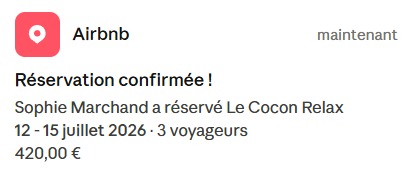
You are on Airbnb. Your guests arrive. Your reviews are great. Everything runs smoothly.
And yet you know you are leaving money on the table, because everyone who searches on Booking.com has no idea you exist.
But every time you think about adding Booking.com, the same fear stops you: what if I end up with two guests on the same weekend, in the same bed?
That fear is legitimate. It is even well founded. But it has been solved for a long time, as long as you understand why the most popular solution (the iCal file) does not really work.
Why the fear of double bookings is legitimate
When you are on two platforms (or more), your calendars need to be aligned at all times. To the second. If Booking.com confirms a reservation 2 minutes after Airbnb confirmed another one for the same dates, you have a double booking. And that gets expensive.
On the Booking.com side
Booking.com requires you to relocate the guest at your own expense, to an equivalent or better property. On a July weekend, that can run to several hundred euros. Plus a negative mark on your host account.
On the Airbnb side
If you cancel because of a double booking, Airbnb hits you with:
- A penalty (€50 to €100 depending on timing)
- The loss of your Superhost status for 12 months
- A "Host cancellation" notice on your listing, visible to future guests
The iCal trap: why it is not enough
Search for "sync Airbnb and Booking.com" and you will land on the same solution everywhere: iCal.
It is a file you exchange between platforms. Airbnb generates an iCal link, you paste it into Booking.com. Booking.com reads that file regularly and blocks the dates accordingly.
The problem: the refresh delay.
| Platform | iCal update frequency |
|---|---|
| Airbnb (reading) | Every 2 to 4 hours |
| Airbnb (writing) | Every 5 to 30 minutes |
| Booking.com (reading) | Every 1 to 4 hours |
| Booking.com (writing) | Every 30 minutes to 2 hours |
| Vrbo | Every 4 to 6 hours |
In practice: between the moment a guest confirms on Airbnb and the moment Booking.com sees those dates as blocked, up to 4 hours can go by.
During those 4 hours, your listing stays available on Booking.com. If someone books, it is confirmed. And there you have it: a double booking.
The typical scenario
- 9:12 am: a guest books on Airbnb for the weekend of July 14, and Airbnb updates its iCal around 9:45.
- 10:30 am: Booking.com reads the iCal and blocks the dates on its side.
- 9:25 am: in the meantime, another guest has booked the same dates on Booking.com. Confirmed.
You wake up the next day with two reservations. It is exactly what the POV video on my account shows, and it is not fiction. It is half of the headaches I deal with in consultations.
The real solution: a direct API connection
A direct API connection (often called a channel manager) is a system that:
- Receives the reservation in real time (within seconds, not hours)
- Updates all the other platforms immediately
- Syncs in both directions (reading AND writing)
- Works 24/7, even while you sleep
In practice: between the moment the guest clicks "Book" and the moment your listing becomes unavailable everywhere else, less than 30 seconds go by.
That difference is what removes the risk of double bookings. Not a marketing promise. A technical fact.
How to check that your tool does a real sync
If you already use a tool (Smoobu, Lodgify, Hospitable, BedLink, or another), here are the questions to ask it:
- Are you connected through the official API or through iCal? If the answer is "iCal", it is a no. The right answer: "Official Airbnb API / official Booking.com API".
- What is your average delay for propagating a reservation between platforms? The right answer: under a minute. The wrong answer: "it depends".
- What happens if a reservation comes in during Airbnb or Booking.com maintenance? The right answer: the system retries the sync at every polling cycle and alerts you if it fails. The wrong answer: "you will be notified by email".
- Are you an official connected partner? Check the partner pages of Airbnb and Booking.com. If the tool is not listed, it is probably iCal in disguise.
The cost of "I'll stay on one platform"
Let's stay on Airbnb. It feels safe, it is familiar, no surprises.
But it also means 100% dependence on one algorithm, one policy, one point of contact. If Airbnb changes its rules tomorrow (it has happened), suspends your listing (it has happened), or changes its refund policy (it happens regularly), you lose everything overnight.
And on the revenue side: depending on the segment, 30 to 50% of travelers search only on Booking.com. To them, you do not exist. For a property making €16,000 a year on Airbnb, that means €5,000 to €8,000 you are not capturing every year.
How to go multi-platform without the risk
If you decide to go multi-platform, here is the order I recommend:
- Audit your current Airbnb listing (title, description, photos, price, rules). Whatever is weak on Airbnb will be weak on Booking.com.
- Choose a tool with a direct API connection (not iCal). It is the only real technical prerequisite.
- Import your blocked dates from Airbnb (personal vacations, seasonal blocks).
- Create the Booking.com listing as a mirror of the Airbnb one (adapted title, slightly more formal description).
- Turn on the API sync in both directions.
- Test with a fake internal reservation on Booking.com (a date 6 months out) to check that it blocks properly on Airbnb. Cancel it afterwards.
- Go live for real.
Counted generously, it is 1 to 2 days of work if you do it yourself. Much less if you delegate.
Want to see BedLink for real?
Leave your details and Simon will get back to you within 24 hours by call or message, to give you access to the demo and talk about your situation.
Request the demo →Going further
- To calculate what a second platform could earn you (revenue estimate plus commission cost), the OTA calculator is free and instant.
- If you want us to look at your current situation together (listings, platforms, estimated loss), that is what the free demo is for. I will call you back the same day.
Simon Laurent, founder of BedLink. I connect Airbnb, Booking.com, Vrbo and 60+ platforms through direct API (not iCal) for owners of guesthouses, B&Bs and Airbnb rentals across France. No double bookings. Promise.